Chapter 3 · Garde Manger
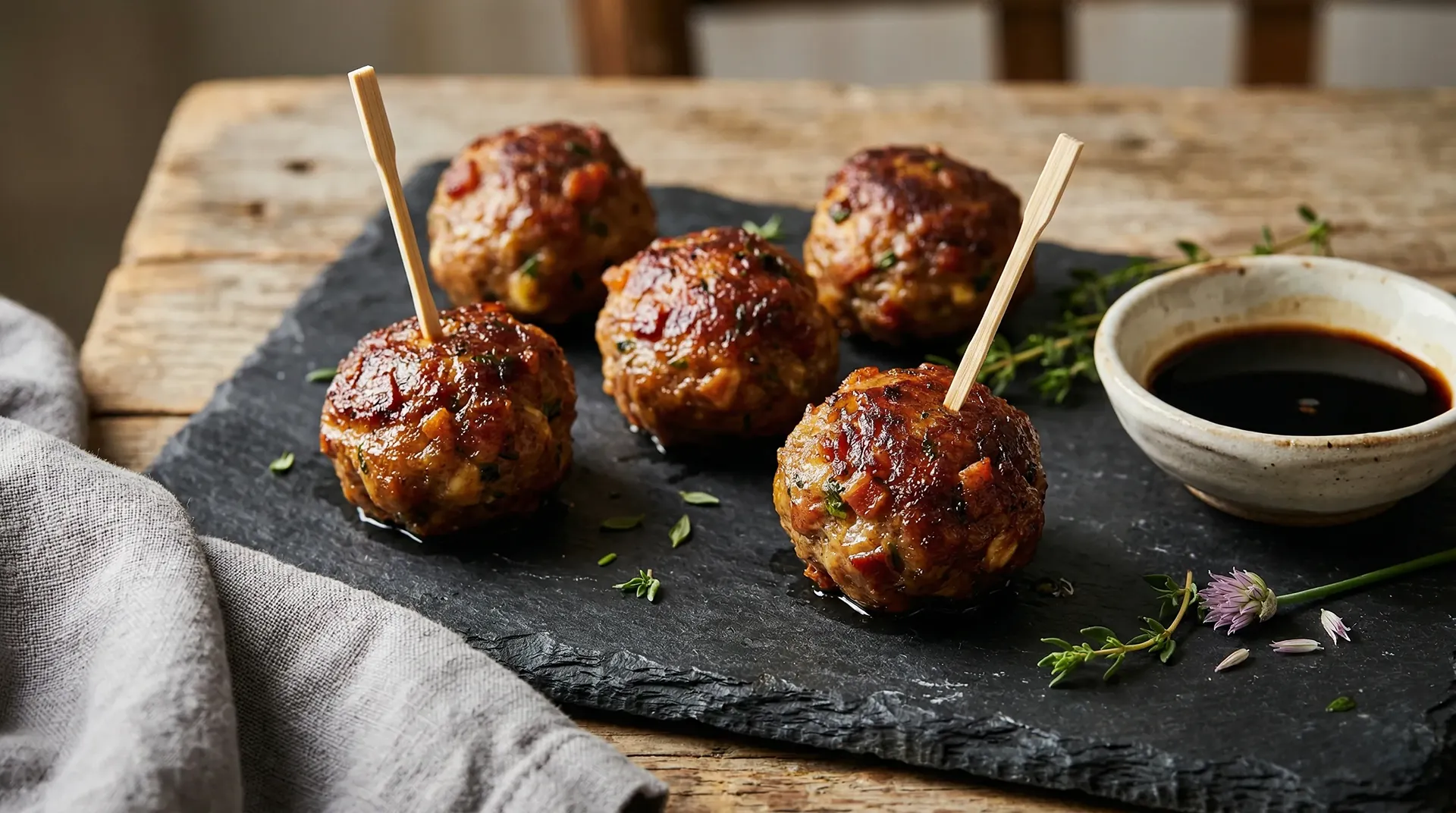
Mini Boursin & Bacon Meatballs
Rich, tender bites enriched with herbed cream cheese and smoky lardons.
Yield: 24–30 meatballs (38 g each) | Prep: 20 min | Cook: 15–18 min | Total: ~35–38 min
Headnote
These meatballs stay remarkably moist without a sauce by combining two moisture-retention strategies: a panade that locks water into the matrix, and Boursin cheese that adds fat and herbed flavor simultaneously. The bacon is rendered separately and folded in, delivering textural contrast — crisp lardon pockets inside a tender, yielding meatball. Originally developed for subs, this mini variant scales down to a size that works equally well as a standalone appetizer or as a soup garnish (see Pollo Rustica). Teaching Idea: The Panade. A panade — starch hydrated in liquid — acts as a physical barrier between protein strands. During roasting, the starch gel absorbs and holds water that would otherwise be squeezed out as myosin contracts. The result is a meatball that stays tender even at a high-heat roast temperature of 425°F/220°C.
Ingredients
The Panade
- 120 g (1 cup) panko breadcrumbs
- 120 ml (½ cup) whole milk
The Bacon
- 4 slices thick-cut bacon (approximately 120 g raw weight, yielding ~50 g cooked)
The Meat Matrix
- 450 g (1 lb) ground beef (80/20)
- 150 g (5 oz) Boursin cheese, Garlic & Fine Herbs variety (room temperature)
- 3 g (1 tsp) Diamond Crystal kosher salt
- 1 g (½ tsp) freshly ground black pepper
Mise en Place (Action Checklist)
- Preheat oven to 425°F/220°C. Line a rimmed baking sheet with parchment paper.
- Dice the bacon into small cubes (lardons) — do not cook yet; rendering happens in Method.
- Temper the Boursin: Remove from refrigerator and allow to reach room temperature (approximately 30 minutes) so it incorporates evenly without breaking the mix.
- Measure and weigh all ingredients. Set up a scale near the workstation for portioning.
Method
Phase 1: Render the Bacon
Dice the bacon into small lardons. Place in a cold skillet and set over medium heat. Cook, stirring occasionally, for 8–10 minutes until the fat has fully rendered and the lardons are crisp and golden.
Sensory Cue: The sizzling will subside as the fat renders out; the lardons should be browned and firm, not soft.
Transfer to a paper towel–lined plate. Cool completely before adding to the meat mix — residual heat will begin cooking the proteins prematurely.
Phase 2: Build the Panade
Combine the panko breadcrumbs and whole milk in a small bowl. Stir briefly to coat. Let stand for 5 minutes.
Why: Hydrating the starch granules in the breadcrumbs creates a gel that physically interrupts myosin network formation during cooking. This keeps the meatball tender even under high roasting heat.
Sensory Cue: The mixture should look like thick, wet paste — no dry crumbs visible. If it looks dry, add milk in 15 ml increments.
Phase 3: Mix the Matrix
In a large bowl, combine the ground beef, room-temperature Boursin, cooled lardon bits, and the fully hydrated panade. Mix gently by hand using a folding motion until just combined — no more than 30–40 seconds of active mixing.
Why: Ground beef contains myosin, a protein that forms elastic strands when agitated. Over-mixing develops an excessive myosin network, producing a dense, rubbery texture. Stop the moment the ingredients are evenly distributed.
Sensory Cue: The mix should hold together when pressed but not feel paste-like or springy. If it springs back, it has been overworked.
Phase 4: Portion and Roast
Using a scale, weigh the mixture into 38 g portions. Roll gently between your palms into rounds — apply light pressure only. Place on the prepared baking sheet, spaced at least 2.5 cm (1 inch) apart to allow hot air to circulate.
Roast at 425°F/220°C for 15–18 minutes.
Sensory Cue: Meatballs should be visibly browned on the bottom and sides, and register an internal temperature of 160°F/71°C on an instant-read thermometer. The exterior should feel firm when pressed, not yielding.
Phase 5: Rest and Serve
For soup garnish: Cool completely on the tray before adding to broth. Hot meatballs added directly to soup will break apart as the surface proteins are still vulnerable. A 10-minute rest at room temperature is sufficient.
For appetizer service: Rest 3–5 minutes, then serve immediately. Plate with a toothpick and, if desired, a small drop of aged balsamic glaze alongside.
Variations
Cheese Substitution: Boursin’s fat content (roughly 72%) and herb profile are integral to both the flavor and moisture retention. If Boursin is unavailable, blend 120 g full-fat cream cheese with 30 g softened unsalted butter, 1 minced garlic clove, and 1 tsp mixed fresh herbs (thyme, chive, parsley). This approximates the fat-to-protein ratio closely enough to maintain texture.
Bacon Variant: Pancetta or guanciale can substitute for American bacon. Both render cleanly and add a more nuanced, less smoky pork flavor — appropriate if the meatballs are being used in a refined soup course rather than as a standalone appetizer.
Chef’s Notes
Make-Ahead and Freezing: Shaped, raw meatballs freeze well. Arrange on a parchment-lined sheet and freeze solid (approximately 2 hours), then transfer to a zip bag. Roast from frozen at 425°F/220°C for 20–22 minutes. Do not thaw first — the extended roast time allows the interior to cook through without drying the exterior.
Scaling Note: Ingredients scale linearly. Roasting time does NOT scale — oven crowding reduces airflow and extends cook time. Roast in batches on separate sheets rather than loading a single sheet past capacity. A crowded sheet will steam rather than roast, producing pale, soft exteriors.
Serving Sizes: At 38 g each, three meatballs constitute a standard appetizer portion. For soup use (Pollo Rustica), two per bowl is the working calibration.
Glossary
- Panade: A paste of starch (typically bread or flour) hydrated in liquid (milk or cream), used to keep ground meat tender by physically interrupting protein network formation during cooking.
- Lardons: Small cubes or strips of fatty bacon that have been rendered until the fat cooks out and the meat crisps. The term comes from the French lard (cured pork fat).
- Render: To cook fat-rich meat over moderate heat so the fat melts out of the tissue, leaving behind crisp, browned solids.
- Myosin: A motor protein in muscle tissue that, when over-agitated during mixing, forms dense elastic networks — the primary cause of rubbery ground meat.
- Mise en place: French for “everything in its place.” The culinary practice of preparing, measuring, and organizing all ingredients and equipment before cooking begins.